Wiz Follow-Up Research -- Operating-Model Patterns Beyond UI Screens
Executive Summary
The first Wiz research note was intentionally screen-centric: findings list, finding detail, overview, access paths, clusters, and filters. That was the right first pass, because Sergey explicitly asked us to study presentation patterns before making more findings UX changes.
This follow-up asks a different question:
What else does Wiz do well operationally -- beyond surface-level screen design -- that SecurityV0 could borrow without compromising the deterministic review-and-action model?
The answer is: quite a bit.
Wiz is not only polished at the page level. It is also strong at turning security work into a visible operating system:
- A program-control surface for leaders that shows maturity, adoption, delegation, and measurable progress.
- A monitored-metrics layer that lets teams save customized views as monitored metrics or widgets and export them as reports.
- Workflow-in-place integrations that let teams investigate, assign, comment, and track progress from the tools they already use.
- A structured split between urgent risk and long-tail posture debt, which gives organizations a more stable cadence after they clear the highest-risk items.
- Stronger ownership and accountability loops: not just "who owns this path," but "which teams are engaging, which integrations are enabled, and where adoption is lagging."
For SecurityV0, these patterns matter because Sergey has repeatedly framed ownership workflows, mitigation tracking, and operating surfaces as the point where the product becomes sticky. The opportunity is not to make SecurityV0 "more like Wiz" in detection philosophy. It is to make SecurityV0 more operational:
- clearer progress signals
- better visibility into who is acting
- better continuity between list/detail/workflow/report
- better executive and team-level readouts
The patterns worth borrowing are therefore not "AI verdicts" or "composite security scores." They are the management scaffolding around action.
Scope of This Follow-Up
This note does not repeat the first Wiz analysis. It focuses on five areas that were either underexplored or only partially translated into backlog items:
- Program operations / champion surfaces
- Monitored metrics, saved views, widgets, and reports
- Workflow integrations that reduce context switching
- Structured hygiene / posture-debt workflows
- Adoption and accountability instrumentation
It also closes with:
- what still appears unclaimed from the first Wiz note
- which ideas fit SecurityV0 cleanly
- which ideas should still be avoided
Methodology
This note uses only official Wiz sources:
- Wiz product blog
- Wiz integration pages
- Wiz platform pages
No direct access to a Wiz tenant was available. Observations are therefore based on public product descriptions, screenshots, and integration write-ups available as of March 30, 2026.
Primary sources used:
- Introducing Wiz Champion Center
- Introducing Wiz Lens
- Hosted Technologies Inventory
- Introducing Posture Issues
- Wiz + ServiceNow workflows
- Wiz Slack bi-directional integration
- Wiz Jira integration
1. Program Control Surfaces
What Wiz Does
The clearest underexplored pattern from Wiz is the Champion Center. This is not just another dashboard. It is an explicit operating surface for the people running the security program.
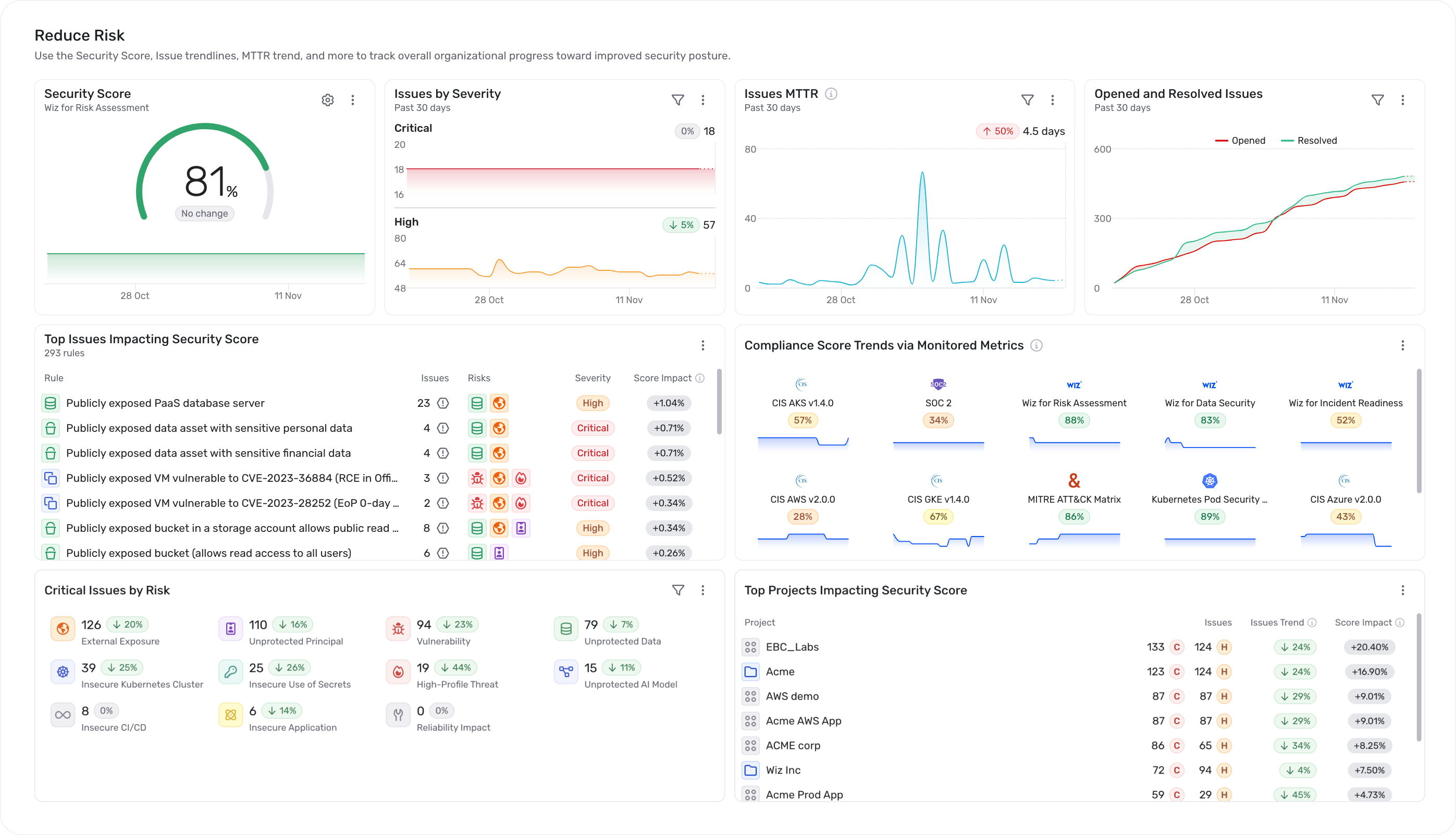 Wiz Champion Center: Security Score (81%) with trendline, Issues by Severity (Critical through Low with counts and trends), MTTR tracking (4.3 days), opened vs. resolved issues over time, top issues impacting score with severity badges, compliance score trends via monitored metrics, and top projects ranked by risk score. Source: Wiz Champion Center blog
From the public Wiz description, Champion Center gives leaders:
- trendlines for key program metrics
- visibility into active users and enabled integrations
- visibility into which projects and teams are engaging
- delegated module champions
- goals, priorities, and deadlines
- milestone / achievement framing
- business-value language for leadership communication
This is important because it reframes security tooling from "where issues live" into "where program maturity is managed."
Why It Matters for SecurityV0
SecurityV0 already has the beginnings of this:
- ownership assignments
- mitigation tracking
- evidence classification
- grouped access-path surfaces
- drift activity
But those capabilities are still distributed across product screens rather than composed into an explicit management cockpit.
The missing layer is something like:
- number of critical paths without a platform owner
- number of overdue mitigations
- number of stale mitigations
- percentage of top-risk paths that are assigned
- number of active reviewers / operators by team
- which teams are actually closing actions vs. only accumulating them
Pattern to Borrow
Borrow the operating-surface concept, not the Wiz Security Score.
For SecurityV0, a good version would be:
- deterministic counts instead of a single composite score
- owner/action/review progression instead of abstract maturity points
- team/accountability visibility instead of gamified scoring
Recommendation
Create a future research or product issue for a SecurityV0 Operations Console on top of the existing ownership + mitigation primitives:
- unowned critical paths
- overdue tracked actions
- stale mitigations
- recently changed high-risk paths
- team/adoption visibility
This aligns strongly with Sergey's "core operating surfaces" framing.
2. Monitored Metrics, Saved Views, Widgets, and Reports
What Wiz Does
The most interesting pattern in the Hosted Technologies research is not the inventory page itself. It is the operational layer around it:
- custom searches, filters, and groupings can be saved as Monitored Metrics
- customized views can also be saved as widgets
- widgets can be used to build personalized dashboards
- views can be exported as reports
This is a much stronger model than "one fixed dashboard for everyone."
Visual reference: The Champion Center screenshot above (Section 1) shows this in practice — note the "Compliance Score Trends via Monitored Metrics" panel in the bottom-right, where saved compliance queries have been turned into trendline widgets on the executive dashboard.
Why It Matters for SecurityV0
SecurityV0 already has several candidate building blocks:
- findings filters
- access-path filters
- grouped/flat access-path views
- cluster filters
- overview metric cards
- reports infrastructure
But these are still mostly one-time views, not reusable monitoring assets.
The follow-up opportunity is:
- save a filtered findings view as "Orphaned ownership this week"
- save an access-path grouped view as "Critical active grouped by identity"
- pin those views as dashboard widgets
- export them as recurring audit / exec / team reports
Pattern to Borrow
Borrow "saved operational views become monitored metrics," not just "more charts."
This would give SV0 a bridge between:
- analyst workflows
- ongoing monitoring
- executive reporting
without requiring a probabilistic score or a new data model.
Recommendation
Research or backlog candidates:
- Saved views for findings and access paths
- Pin-to-dashboard widgets from customized views
- Report generation from saved filtered views
This is probably a better next step than inventing brand-new metrics from scratch.
3. Workflow-in-Place Collaboration
What Wiz Does
Wiz is strong at bringing action into adjacent systems rather than forcing the user back into Wiz for every status update.
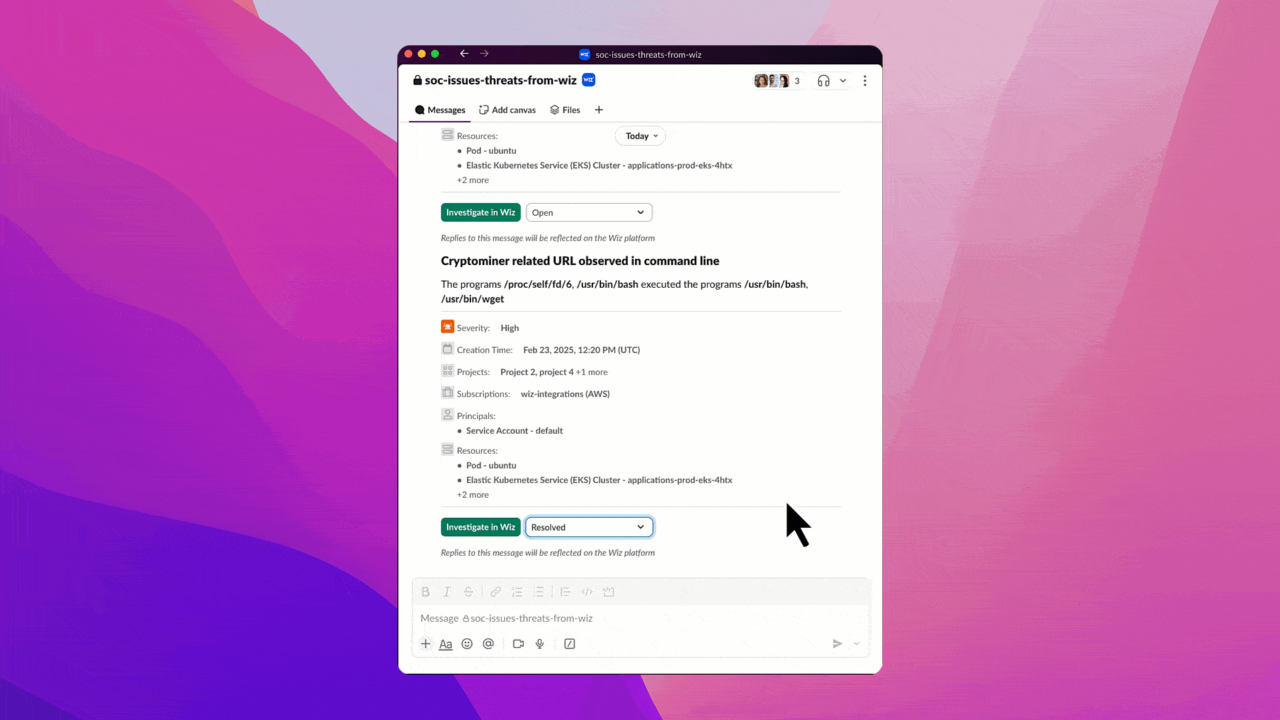 Wiz issue card in Slack: "A production related URL observed in command line" with severity, timestamps, remediation progress, and action buttons — all bi-directional, so status changes and comments in Slack sync back to Wiz. Source: Wiz Slack Integration blog
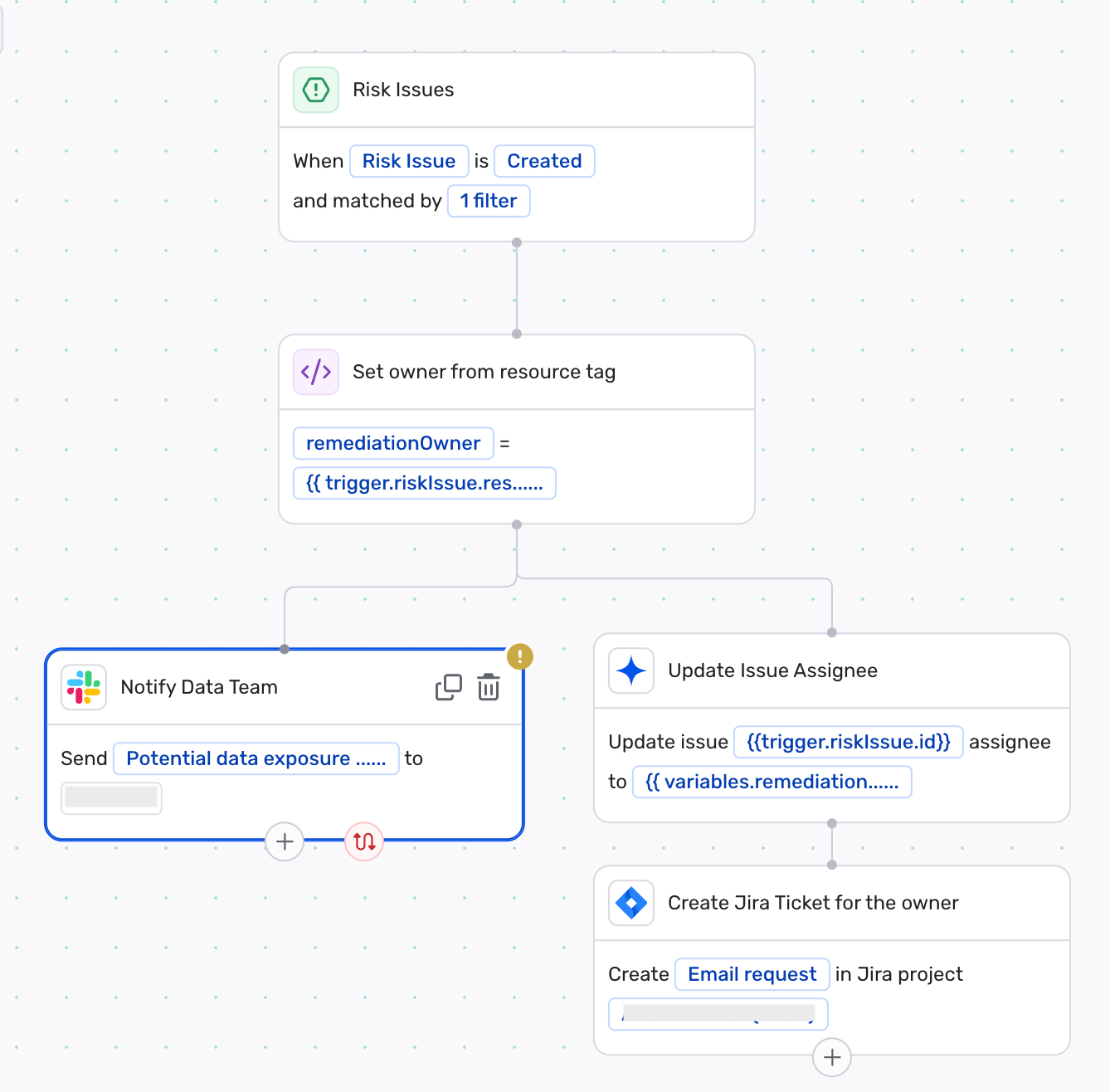 Wiz Workflows drag-and-drop builder: trigger on "Risk Issue Created," auto-set owner from resource tag, then branch into parallel actions — Slack notification to data team, update assignee, create Jira ticket. Source: Wiz Workflows blog
The public examples are explicit:
- Jira tickets are created with rich context
- ServiceNow gets both inventory and vulnerability context
- Slack supports bi-directional issue and threat workflows
- comments and status changes sync back into the originating system
The critical design idea is not "integrations exist." It is:
the workflow stays live outside the product, but the product remains the system of context.
Why It Matters for SecurityV0
SecurityV0 now has mitigation tracking and ownership assignment, but much of the operating loop still depends on the user staying inside the SV0 UI.
The Wiz comparison suggests a stronger direction:
- allow Slack/Jira/ServiceNow to be action surfaces
- keep SV0 as the authoritative source of path context, evidence, and deterministic remediation rationale
- sync status and comments back into SV0 audit surfaces
This is particularly relevant for SecurityV0 because the product's "stickiness" is tied to ownership and action workflows, not just insight quality.
Pattern to Borrow
Borrow bi-directional workflow updates and context-rich ticketing.
For SecurityV0, this could mean:
- mitigation actions pushed to Jira with richer path/evidence/remediation context
- Slack notifications that allow assignee/status updates without losing audit trace
- comments from workflow tools mirrored back into mitigation history
Recommendation
This deserves a separate research/implementation track after the current UX wave:
- ticket sync semantics
- comment sync semantics
- authoritative status rules
- which transitions can happen outside SV0
Do not borrow the Slack AI assistant pattern. The right takeaway is workflow-in-place, not AI Q&A.
4. Structured Posture Debt, Not Just Urgent Risk
What Wiz Does
The Posture Issues launch introduces a useful operating distinction:
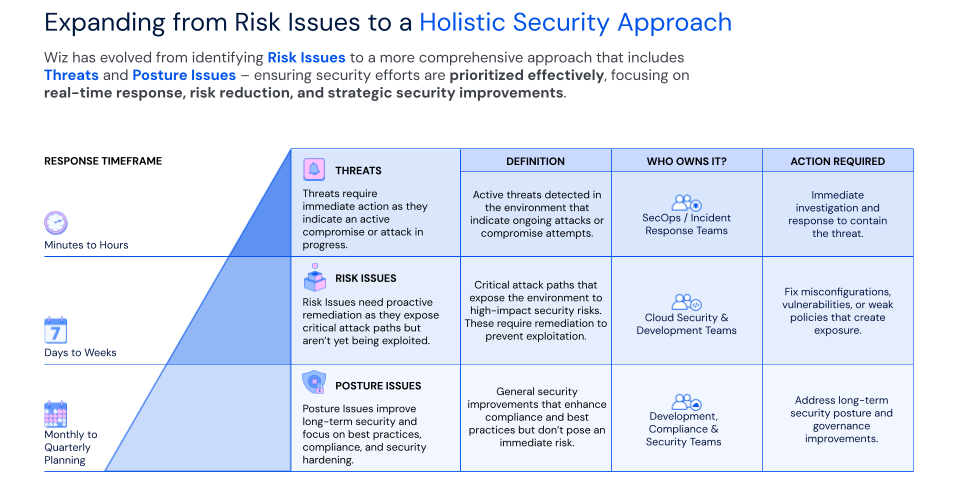 Wiz's two-tier issue model: Runtime Threats, Risk Issues (toxic combinations across domains), and Posture Issues (single-domain findings for hygiene/compliance). Each tier has distinct workflows and SLA cadences. The key insight is the explicit separation between "fix now" and "maintain over time." Source: Wiz Posture Issues blog
- Risk Issues for urgent, high-priority attack-path risk
- Posture Issues for the long tail of findings that matter for hygiene, compliance, and long-term resilience
This is a process pattern more than a UX pattern. It gives organizations a stable operating mode after the top emergencies are cleared.
Why It Matters for SecurityV0
SecurityV0 currently surfaces different finding types, but its operating model is still largely one list / one queue / one detail flow.
The Wiz comparison suggests a valuable distinction:
- critical access-path risks needing immediate review/action
- slower-burn hygiene programs like orphaned ownership cleanup, ownership decay, stale review cadences, or recurring drift classes
This does not mean SecurityV0 should group findings exactly like Wiz. Our findings are path-specific and deterministic. But it may mean the product needs a clearer distinction between:
- urgent risk queue
- hygiene / maintenance queue
Pattern to Borrow
Borrow the operating split between immediate risk and maintenance backlog.
Possible SV0 translation:
- "Urgent Review Queue" for high-severity active findings on reachable/executed paths
- "Hygiene Backlog" for orphaned ownership, dormant-but-still-authorized paths, repeated drift, unreviewed paths beyond cadence
Recommendation
This should likely be explored as a product and information-architecture question, not a pure UI issue. It could become a second-stage follow-up once the current list/detail improvements settle.
5. Adoption and Accountability Instrumentation
What Wiz Does
A pattern that did not get enough attention in the first note is how often Wiz exposes who is engaging and where adoption is lagging:
- active users
- enabled integrations
- projects in use
- business-unit/team engagement
- progress against goals
This is not just nice-to-have telemetry. It helps security leaders understand whether the program is actually moving.
Why It Matters for SecurityV0
SecurityV0 is moving toward core operating surfaces around ownership and mitigations. Once those exist, leadership will inevitably ask:
- Which teams are actually assigning owners?
- Which teams are closing mitigations?
- Where do actions go stale?
- Which integrations are configured but unused?
- Which parts of the estate remain unreviewed?
Those are adoption and accountability questions, not detection questions.
Pattern to Borrow
Borrow "usage and accountability as product surfaces."
This could look like:
- mitigations created by team / completed by team
- average time to first assignment
- percent of critical paths with owner
- percent of tracked actions overdue
- recent action velocity by business unit or connector domain
Recommendation
This is a strong candidate for executive/operations reporting after the current UX fixes. It could also make the existing reports feature substantially more valuable.
What Still Looks Unclaimed From The First Wiz Note
This follow-up research also surfaced three items from the first Wiz note that still appear only partially realized in the product:
-
Full finding description visibility The findings list still clamps description text, even though the first research note treated full inline visibility as one of the highest-value changes.
-
Tracked-action status on access-path list rows The first note explicitly called for tracking status on list views. The access-path list still appears to lack a first-class per-row mitigation indicator.
-
True trend sparklines The first note argued for trajectory visuals, not just delta hints. If the current implementation only shows direction/delta badges, the Wiz-inspired outcome is only partial.
These are not "new research" items, but they should remain visible as open value from the original comparison.
Best-Fit Patterns To Borrow Next
If we want the highest-value Wiz-inspired follow-ups that still fit SecurityV0's product boundaries, the strongest candidates are:
-
Operations console / champion surface Use deterministic owner/action/review metrics rather than a composite security score.
-
Saved views, monitored metrics, widgets, and reports Turn existing filtered workflows into reusable monitoring surfaces.
-
Bi-directional workflow integrations Reduce context switching while keeping SV0 as the source of evidence and audit history.
-
Urgent queue vs hygiene backlog Separate "fix now" work from long-tail posture maintenance.
-
Adoption / accountability instrumentation Show which teams are engaging, closing actions, and improving posture.
Patterns To Avoid
These remain poor fits for SecurityV0 even in this follow-up lens:
-
Single composite Security Score This weakens the deterministic model and obscures path-level truths.
-
AI verdict layers SecurityV0's core value is evidence-backed deterministic conclusions, not another interpretive layer.
-
AI chat as a primary interface Natural language helpers may be useful later, but they are not the right operating-surface priority now.
-
Auto-remediation / automated governance enforcement This would cut across the human-review workflow that differentiates the product.
Recommendation
The first Wiz note answered: "How should the screens improve?"
This second note answers: "How should the product feel more operational once the screens improve?"
If SecurityV0 wants to borrow more from Wiz without drifting away from its identity, the next research and product work should focus on:
- deterministic operating surfaces for leaders and reviewers
- reusable monitored views and widgets
- context-rich workflow integrations
- explicit posture-maintenance workflows
- accountability metrics around ownership and mitigation progress
The key idea is not to imitate Wiz's graph-first detection engine. It is to adopt more of Wiz's program-operating discipline around visibility, routing, progress, and accountability.
Sources
| Source | URL | Why It Matters | Accessed |
|---|---|---|---|
| Champion Center | https://www.wiz.io/blog/introducing-wiz-champion-center | Program maturity, delegation, trendlines, adoption visibility | 2026-03-30 |
| Wiz Lens | https://www.wiz.io/blog/introducing-wiz-lens-role-based-views-for-every-security-team | Role-scoped views and audience-specific operating surfaces | 2026-03-30 |
| Hosted Technologies Inventory | https://www.wiz.io/blog/hosted-technologies-inventory | Monitored metrics, widgets, personalized dashboards, exports | 2026-03-30 |
| Posture Issues | https://www.wiz.io/blog/introducing-posture-issues-transform-security-findings-into-actionable-outcomes | Structured long-tail posture workflows and SLA/backlog framing | 2026-03-30 |
| Wiz + ServiceNow | https://www.wiz.io/blog/enhance-existing-security-workflows-wiz-servicenow | Context-rich workflows inside existing ITSM/CMDB systems | 2026-03-30 |
| Wiz + Slack | https://www.wiz.io/blog/slack-ai-app-for-wiz-integration | Bi-directional workflow updates and in-channel action handling | 2026-03-30 |
| Wiz + Jira | https://www.wiz.io/integrations/jira | Context-rich ticketing within existing developer workflows | 2026-03-30 |